
ICSI

ICSI treatment in Goa — precision for male factor infertility.

A single, carefully selected sperm injected directly into the egg — the primary treatment for male factor infertility, performed in our own lab by our resident embryologist.

Book a free consultation

ICSI — Intracytoplasmic Sperm Injection — is a technique in which a single, carefully selected sperm is injected directly into an egg using a fine glass needle. It is now used in the majority of IVF cycles worldwide, and is the primary treatment for male factor infertility in assisted reproduction.

Where conventional IVF places thousands of sperm in a dish alongside each egg and allows fertilisation to occur naturally, ICSI removes that uncertainty. The embryologist selects the best available sperm and injects it precisely into the egg — giving fertilisation the best possible chance even when sperm count, motility, or morphology is significantly reduced.

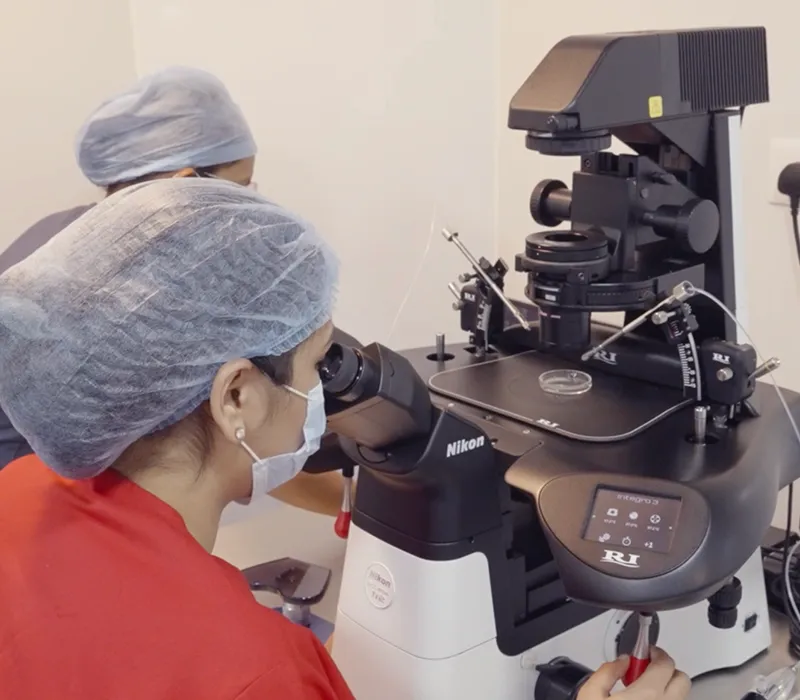
At White Stork IVF, ICSI is performed by Vani, our resident senior embryologist, in our on-site laboratory. The precision of this procedure depends entirely on the skill and experience of the embryologist performing it — which is why having a dedicated, on-site specialist matters.

At White Stork IVF

ICSI is now used in roughly 80% of all IVF cycles globally — not only for male factor infertility but in many cases as a precaution to optimise fertilisation rates. Your doctor and embryologist will discuss whether ICSI is the right approach for your specific situation.

Who it’s for

Who is ICSI for?

  • Men with low sperm count (oligospermia) or no sperm in the ejaculate (azoospermia — in combination with TESA/TESE).
  • Cases of poor sperm motility (the sperm do not swim effectively).
  • Abnormal sperm morphology (the sperm are not the right shape).
  • Previous IVF cycles where fertilisation was absent or very low with conventional insemination.
  • Men who have had a vasectomy or other obstructive causes of low sperm in the ejaculate.
  • Use of frozen sperm (from donor or stored samples) where sperm numbers may be limited.
Questions

Frequently asked questions.

Does ICSI improve pregnancy rates compared to conventional IVF?

For couples with male factor infertility, ICSI significantly improves fertilisation rates compared to conventional IVF. For couples with no male factor, the evidence is more mixed — fertilisation rates are similar, but ICSI does ensure fertilisation in cases where it might otherwise be uncertain. Your team will advise on whether ICSI is indicated for your case.

Is ICSI safe for the resulting child?

Extensive research over 30 years shows that children born through ICSI have no higher rates of major congenital abnormalities than those conceived naturally or through conventional IVF. In cases where male infertility has a genetic component, there is a small possibility that male children may inherit the same fertility challenges — this can be discussed at your consultation.

Can ICSI be used with frozen sperm?

Yes. ICSI is the preferred method when using frozen sperm — whether from a prior storage, a donor, or retrieved via TESA/TESE — because it allows a small number of sperm to be used effectively.

Is the ICSI procedure painful for the egg?

The ICSI injection does not affect the quality of the egg or the resulting embryo when performed correctly by an experienced embryologist. The physical toll of ICSI on the patient is the same as conventional IVF — the difference is entirely what happens in the laboratory.

How much does ICSI add to the cost of IVF?

ICSI involves an additional laboratory step and specialist embryologist time. We include a transparent breakdown of all costs — including ICSI where applicable — in your treatment plan before you commit to anything.

Ready to take the next step?

Your first consultation at White Stork IVF is completely free. No referral needed. No commitment. Speak with our team in Dona Paula, Goa.

+91 99719 13399
Dona Paula, Goa
Free first consultation
WhatsApp Call