
Social Egg Freezing

Social egg freezing in Goa — your fertility, your timeline.

Freeze your eggs at their current biological quality and store them until you are ready. A way to extend your reproductive window, on your own terms.

Book a free consultation

Social Egg Freezing — also called elective egg freezing or fertility preservation — allows women to freeze their eggs at their current age and store them for future use. It is a way of extending your reproductive window: the eggs you freeze today retain the biological quality they have now, regardless of when you choose to use them.

The decision to freeze eggs is deeply personal. Some women freeze eggs because they have not yet met the right partner. Some are focused on their career or education. Some are facing a medical treatment — such as chemotherapy — that may affect future fertility. Whatever the reason, the right time to freeze eggs is when you are ready — and the earlier in your reproductive years you freeze, the better the quality of the eggs you store.

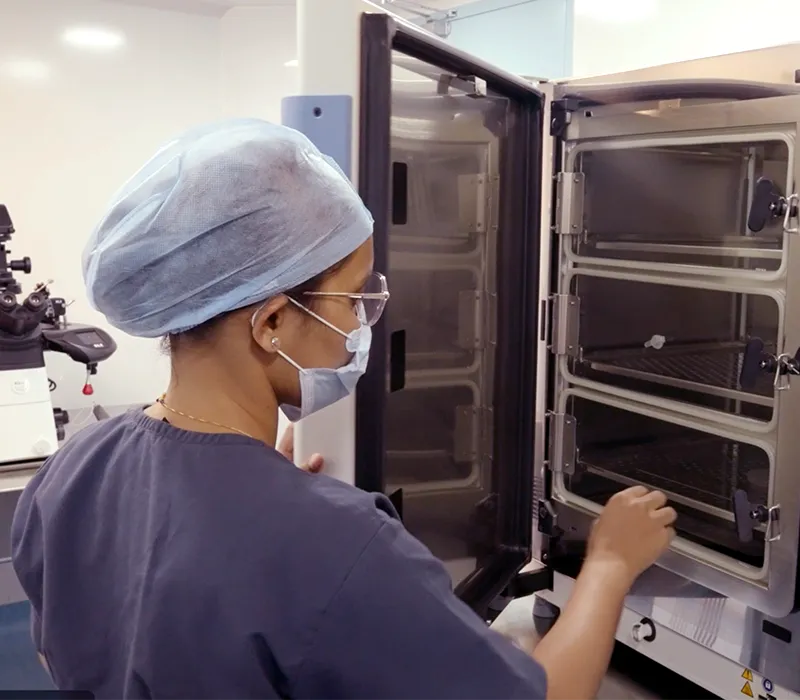
At White Stork IVF, we approach egg freezing with the same care as any IVF cycle. Vani, our resident senior embryologist, personally oversees the vitrification process — the advanced flash-freezing technique that gives stored eggs the best chance of survival when the time comes to use them.

The Process

How social egg freezing works.

STEP 1

Consultation and assessment

Your doctor assesses your ovarian reserve through blood tests (AMH) and an ultrasound scan to understand how many eggs you are likely to produce in a cycle and whether now is the right time to freeze.

STEP 2

Ovarian stimulation

For 8–12 days, daily injections stimulate your ovaries to produce multiple mature eggs. You will have monitoring scans throughout.

STEP 3

Trigger injection

A final injection triggers the last stage of egg maturation before retrieval.

STEP 4

Egg retrieval

Under light sedation, mature eggs are collected from the follicles using a fine needle guided by ultrasound.

STEP 5

Vitrification

Mature eggs are immediately flash-frozen using our vitrification protocol. This is the most critical step in egg freezing — the quality of vitrification directly affects survival rates when the eggs are later thawed.

STEP 6

Secure storage

Your eggs are stored in clearly labelled, monitored cryogenic storage at our clinic.

Who it’s for

Who should consider freezing their eggs?

  • Women in their late 20s or 30s who are not yet ready to start a family but want to preserve their options.
  • Single women who want to have a biological child in the future, with or without a partner.
  • Women about to undergo cancer treatment or other medical interventions that may damage ovarian function.
  • Those diagnosed with conditions that may affect future fertility (e.g., endometriosis, premature ovarian insufficiency).
  • Women who want to use their eggs with a future partner, including same-sex couples planning a family.
Timing matters

The ideal age to freeze your eggs.

Egg quality and quantity decline with age — this is a biological reality. The earlier eggs are frozen, the higher their quality. Women under 35 tend to produce more eggs per cycle and with higher developmental potential. Freezing after 38 is still possible and sometimes worthwhile, but the expected outcomes are different. Your doctor will give you an honest assessment at your consultation.

At White Stork IVF

We do not advocate egg freezing as a guarantee of future pregnancy — it is a way of improving your options, not a certainty. We believe in giving you the clearest possible picture of what egg freezing can and cannot offer, so that you can make a decision that is right for you.

Questions

Frequently asked questions.

How many eggs should I freeze?

The general guidance is that 10–15 mature eggs give a reasonable chance of one successful pregnancy at a later stage. Some women may need more than one stimulation cycle to reach this number. Your doctor will estimate how many eggs you are likely to retrieve based on your ovarian reserve.

How long can eggs be stored after freezing?

Eggs can be stored for many years with no significant loss of quality — documented storage periods of 10+ years with successful use are on record. Indian regulations and clinic protocols will be discussed at your consultation.

What is the difference between egg freezing and embryo freezing?

Egg freezing stores unfertilised eggs — you do not need a sperm partner at the time of freezing. Embryo freezing stores already-fertilised embryos and requires sperm at the time of the procedure. For single women or those without a current partner, egg freezing is the appropriate choice.

Does egg freezing affect future natural fertility?

The stimulation and retrieval process removes eggs that would otherwise be lost naturally in that cycle. It does not deplete your remaining egg reserve beyond what would have happened anyway. The procedure has no known long-term effect on future natural fertility.

What happens when I am ready to use my frozen eggs?

When you decide to use your stored eggs, they are thawed in our lab, fertilised with sperm (your partner's or a donor's), and the resulting embryos are transferred in a Frozen Embryo Transfer cycle. Your doctor will discuss the process in full when the time comes.

Ready to take the next step?

Your first consultation at White Stork IVF is completely free. No referral needed. No commitment. Speak with our team in Dona Paula, Goa.

+91 99719 13399
Dona Paula, Goa
Free first consultation
WhatsApp Call